ELIDEK Logo

CARDILAS

Endoscopic Laser Bioprinting for Cartilage Regeneration

3rd Call for H.F.R.I.’s Research Projects to Support Faculty Members & Researchers Learn More

Project Information

Project ID: 24996
Acronym: CARDILAS
Decision of the HFRI Director
Ref. No.:
113240/01-10-2025
Project Funding: 281,971.00 €
Duration: 48 months
Funding Programme: HFRI
Status: Active

Overview

CARDILAS develops cutting-edge endoscopic laser bioprinting technology for minimally invasive cartilage regeneration using Laser-Induced Forward Transfer (LIFT).

Read more

Objectives

Develop and validate an integrated endoscopic laser bioprinting system for in-situ bioprinting of cells for cartilage regeneration with high precision and cell viability.

Read more

Impact

Revolutionize cartilage repair treatments with minimally invasive procedures, reducing patient recovery time and improving clinical outcomes.

Read more

Project Overview

CARDILAS (Cartilage Regeneration via Direct Intra-articular Laser-Assisted Bioprinting System) is an innovative research project that aims to develop a groundbreaking endoscopic laser bioprinting platform for the regeneration of articular cartilage.

The project leverages advanced Laser-Induced Forward Transfer (LIFT) technology to enable precise, minimally invasive printing of cell-laden Bioinks with Mesenchymal Stem Cells (MSCs) and appropriate growth factors directly onto damaged cartilage surfaces within the joint environment.

By combining state-of-the-art laser technology with novel biomaterials and endoscopic instrumentation, CARDILAS seeks to transform the treatment paradigm for osteoarthritis and cartilage injuries, offering patients a less invasive alternative to traditional surgical interventions.

CARDILAS Endoscopic Laser Bioprinting Device

Scientific Objectives

The CARDILAS project pursues ambitious scientific goals to advance the field of regenerative medicine:

  • 1
    Develop a digital process for Laser Printing of cells: Optimazation of printing parameters to achieve high spatial resolution and high printing velocities sufficient for real-time intraoperative applications.
  • 2
    Develop a digital process for Photopolymerization of bioinks: A photopolymerization module will be integrated into the digital pipeline, enabling on-demand crosslinking of hydrogel scaffolds immediately following cell deposition.
  • 3
    Develop an Endoscopic LIFT System: Design and build a miniaturized laser bioprinting head with photopolymerization module compatible with standard arthroscopic instrumentation.
  • 4
    Optimize Bioink Formulations: Engineer novel hydrogel-based bioinks with optimal rheological properties for LIFT printing that demonstrate high cell viability with maintained chondrogenic phenotype.
  • 5
    Validate In Vivo Efficacy: Conduct preclinical studies to demonstrate cartilage regeneration in animals and phantom organs.
  • 6
    Establish Clinical Translation Pathway: Develop commercialization roadmaps and standardized testing protocols to facilitate the future clinical implementation and market adoption.

Methodology & Innovation

CARDILAS employs cutting-edge technologies and innovative approaches to achieve its groundbreaking objectives.

Laser-Induced Forward Transfer (LIFT)

LIFT Technology

High-precision laser printing technique enabling cell printing with micrometer-level accuracy and selective deposition of cell-laden bioinks.

Endoscopic Integration

Miniaturized Optics

Novel optical fiber delivery system and miniaturized printing head designed for seamless integration with arthroscopic surgical platforms.

Advanced Bioinks
Advanced Bioinks

Biomaterials

Development of specialized hydrogel formulations optimized for laser printing, cell encapsulation, and integration with native cartilage tissue.

Expected Impact

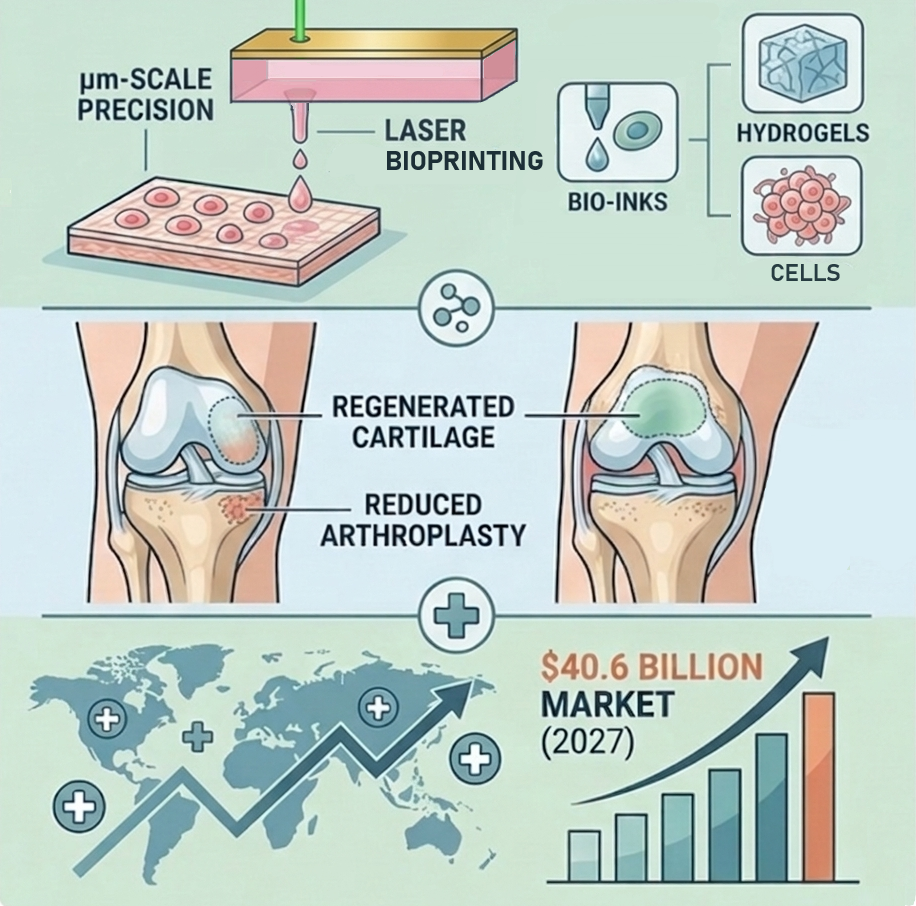
CARDILAS is poised to deliver significant scientific, clinical, and societal impacts:
Scientific Impact

  • Precision and Customization: LIFT technique enables µm-scale control over shape, size, and composition, producing patient-specific tissue constructs that closely mimic anatomical characteristics.
  • Accelerated R&D: Laser printing speeds up iteration of designs and formulations, leading to faster discoveries in tissue regeneration.
  • Innovative Biomaterials: Facilitates the use of biodegradable polymers, hydrogels, and bio-inks that enhance cell growth and tissue development.

Societal Impact

CARDILAS Impact